Validation & results

Measured and validated by the people you'd hire to check us — if you could hire them.

$15M+ of federal, state and utility-funded testing over 10 years — NREL instrumented field studies, the Navy Engineering & Expeditionary Warfare Center, DoD ESTCP validations, GSA Green Proving Ground, DOE programs, California's CalNEXT emerging-technology program, the California Energy Commission and the Electric Power Research Institute. Not vendor models — nine independent entities.

DOE FEMPnational award — won against global competition
SecNavSecretary of the Navy Energy Excellence Award
3×DoD ESTCP program wins
19federal awards in total, across 9 federal agency investors

HEDS was the only HVAC technology named by name in the DoD's High Performance & Sustainable Buildings Report to Congress · DOE "Call for Innovation" winner · USAF AFWERX "Base of the Future" challenge winner

The off-switch test

NREL turned HEDS off for a week. The meters answered.

At the Timken Museum, with baseline conditions restored for seven days, consumption immediately reverted — then fell again when HEDS was re-enabled. The cleanest causality test an efficiency technology can face.

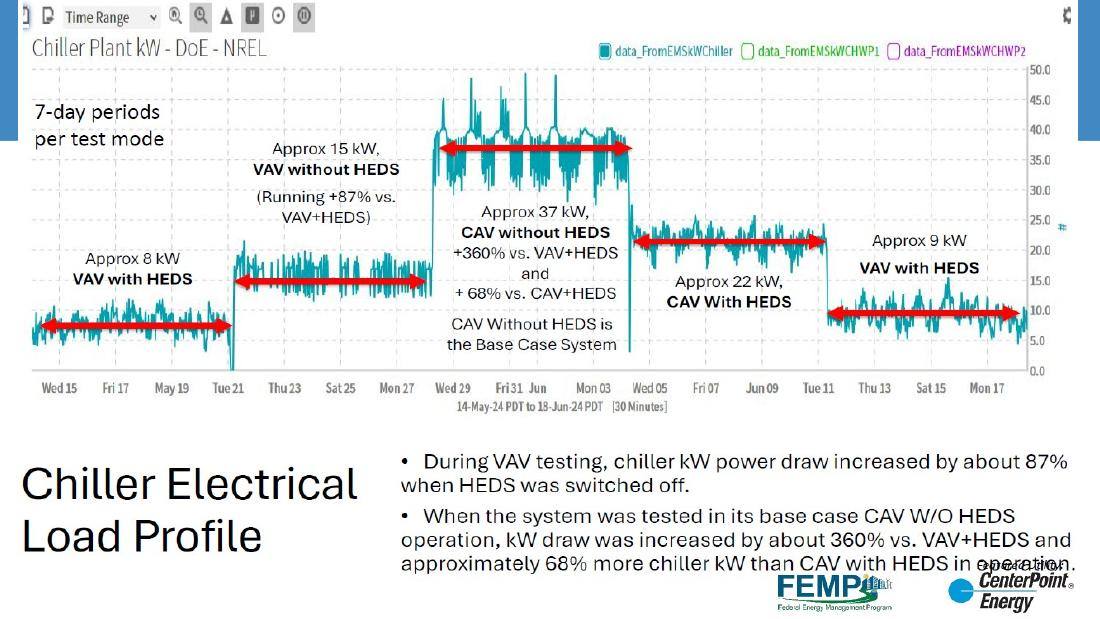
+87%HVAC electrical consumption the week HEDS was switched off
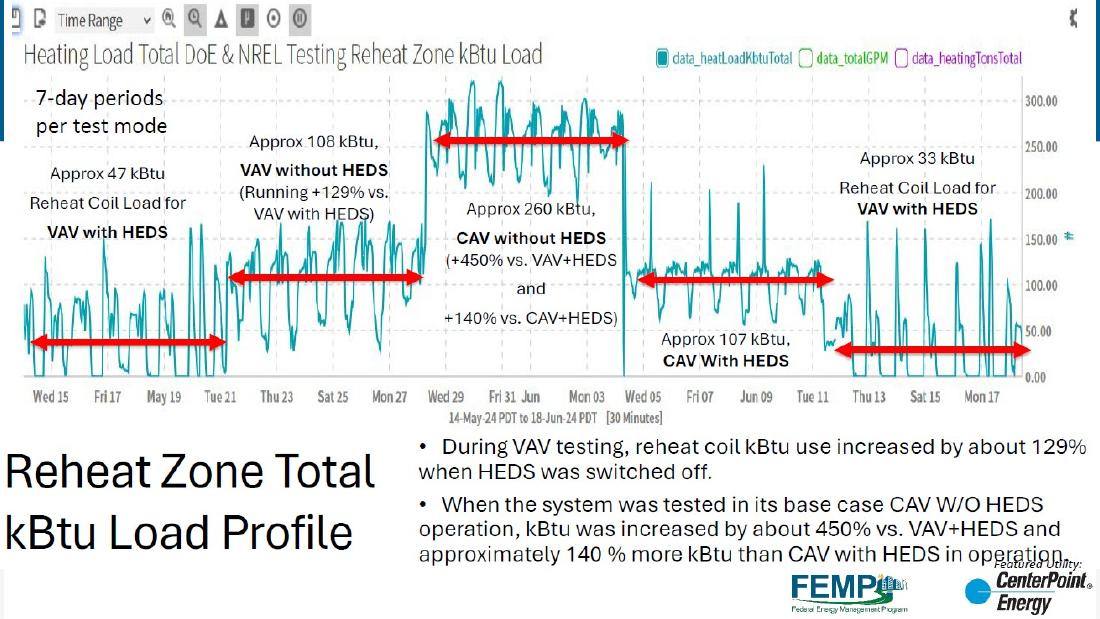
+129%fossil-fuel consumption that same week
75%+annual savings found by CalNEXT's independent evaluation — which recommended statewide utility incentives for HEDS

CalNEXT measured all three conversion paths (annual savings)

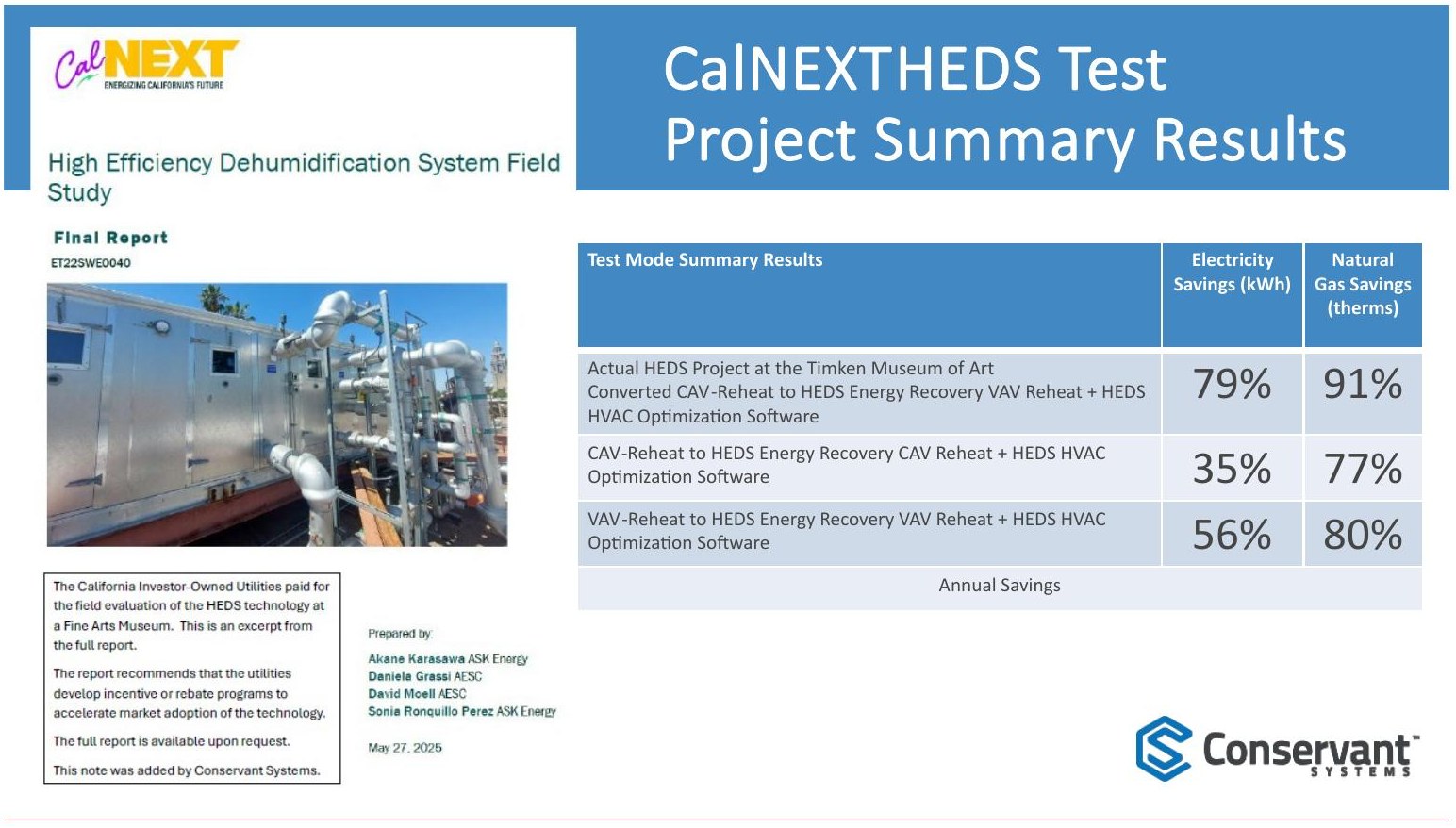
CalNEXT Timken Museum field study: annual savings by conversion path
Test mode — Timken Museum field study (ET22SWE0040)ElectricityNatural gas
Actual HEDS project — CAV-reheat converted to HEDS energy-recovery VAV reheat + HEDS optimization software79%91%
CAV-reheat to HEDS energy-recovery CAV reheat + HEDS optimization software35%77%
VAV-reheat to HEDS energy-recovery VAV reheat + HEDS optimization software56%80%

Prepared by ASK Energy & AESC for the California IOUs · final report May 2025 · full report available on request

DoE-NREL chiller plant kW meter profile across test modes: about 8 kW VAV with HEDS, 15 kW VAV without HEDS (+87%), 37 kW CAV without HEDS (+360% vs VAV+HEDS), 22 kW CAV with HEDS, back to 9 kW VAV with HEDS
Chiller electrical load profile · 7-day periods per test mode · DoE-NREL metering, featured by FEMP
DoE and NREL reheat zone kBtu load profile: about 47 kBtu VAV with HEDS, 108 kBtu without HEDS (+129%), 260 kBtu CAV without HEDS, 107 kBtu CAV with HEDS, 33 kBtu VAV with HEDS
Reheat zone total kBtu load profile · the same off-switch weeks, on the heating side

Featured projects

Four projects, told in full.

Selected from a decade of federal, healthcare, museum and international deployments — every one exceeding 50% measured HVAC savings. Testing was conducted across a range of dew point temperatures to determine the savings for different load types. More case studies to follow — ask us about the ones we haven't written up here, or see the platform running live: dashboard, optimization logic, real meters. That's a conversation, not a video. Schedule a live walkthrough →

Naval Weapons Station Seal Beach

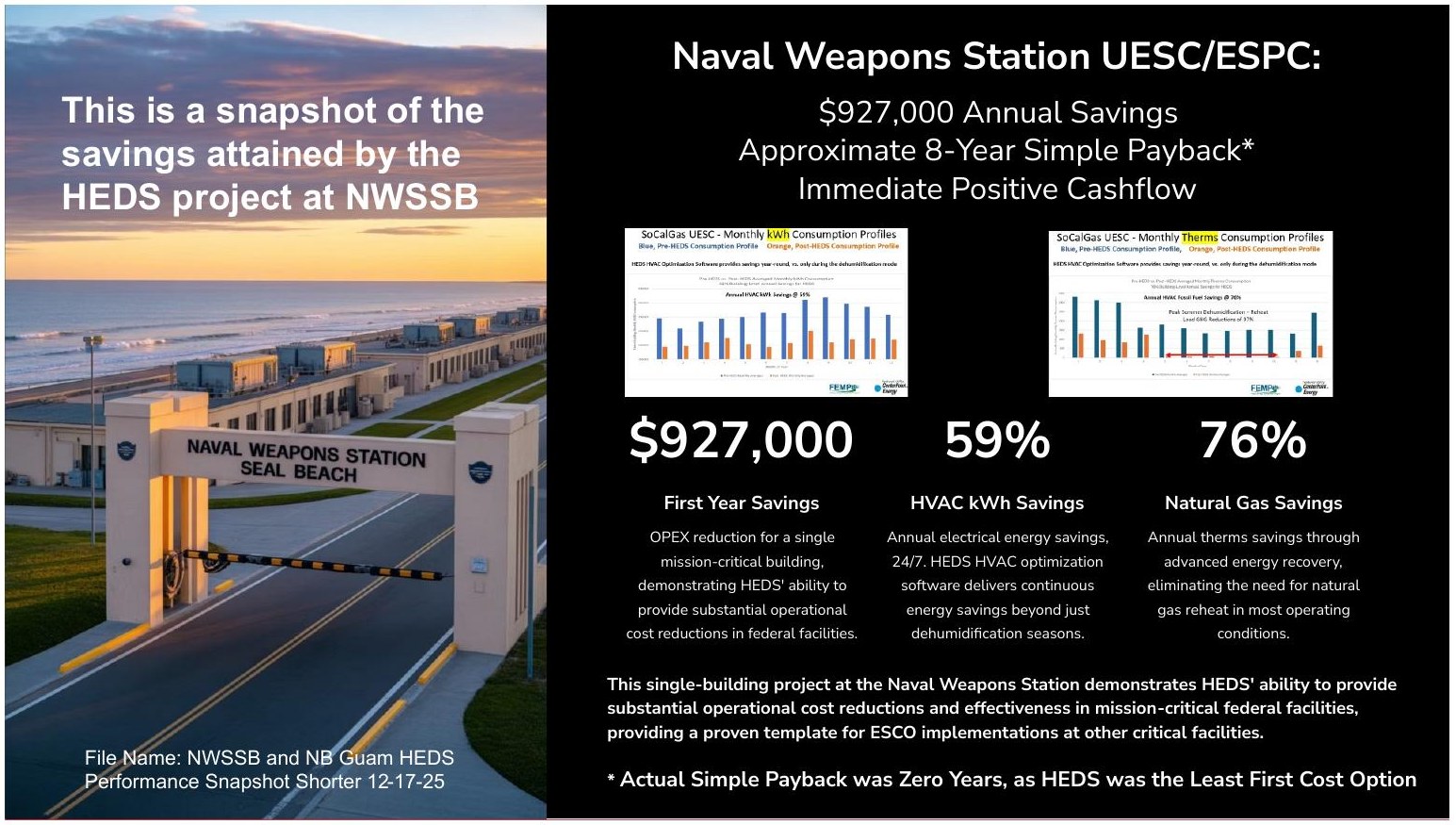
A 25-year-old system couldn't hold spec for weapons maintenance — work stopped when conditions drifted. The Navy replaced nearly the entire HVAC plant with HEDS through a UESC with SoCalGas, whose evaluation found HEDS the lowest first cost, energy cost, maintenance cost and lifecycle cost of every option. Positive cash flow from day one under the UESC — an effective zero-year payback relative to the alternatives evaluated (approximately 8-year simple payback overall) — with hospital-grade air at a salt-air coastal site. Secretary of the Navy Energy Excellence Award, 2021. Monthly metered pre/post consumption profiles (SoCalGas M&V) show savings in every month of the year — not just dehumidification season — including 97% peak-summer reheat GHG reductions.
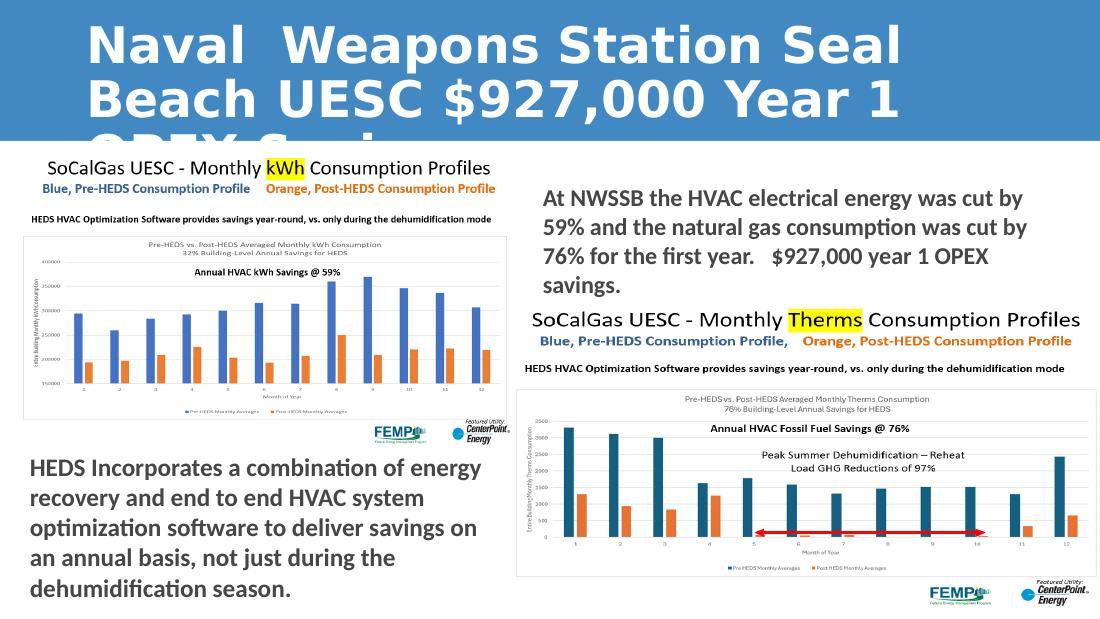
Naval Weapons Station Seal Beach UESC: monthly pre-HEDS versus post-HEDS kWh and therms consumption profiles, 59% annual HVAC kWh savings and 76% annual fossil-fuel savings, $927,000 year-one OPEX savings
SoCalGas UESC M&V · monthly pre/post consumption · featured by DOE FEMP
Snapshot of the savings attained by the HEDS project at NWSSB — Naval Weapons Station UESC/ESPC: $927,000 annual savings, approximate 8-year simple payback, immediate positive cashflow; 59% HVAC kWh savings and 76% natural gas savings; actual simple payback was zero years, as HEDS was the least first cost option
Naval Weapons Station UESC/ESPC snapshot · $927,000 · 59% kWh · 76% gas · least first cost option

Fort Bragg, NC & Tinker AFB, OK

The foundational federal validation (ESTCP EW-201344), run by USACE-CERL across an Army dining facility with heavy latent loads and a USAF warehouse converted into an office building. Testing spanned the full dehumidification season at both sites.

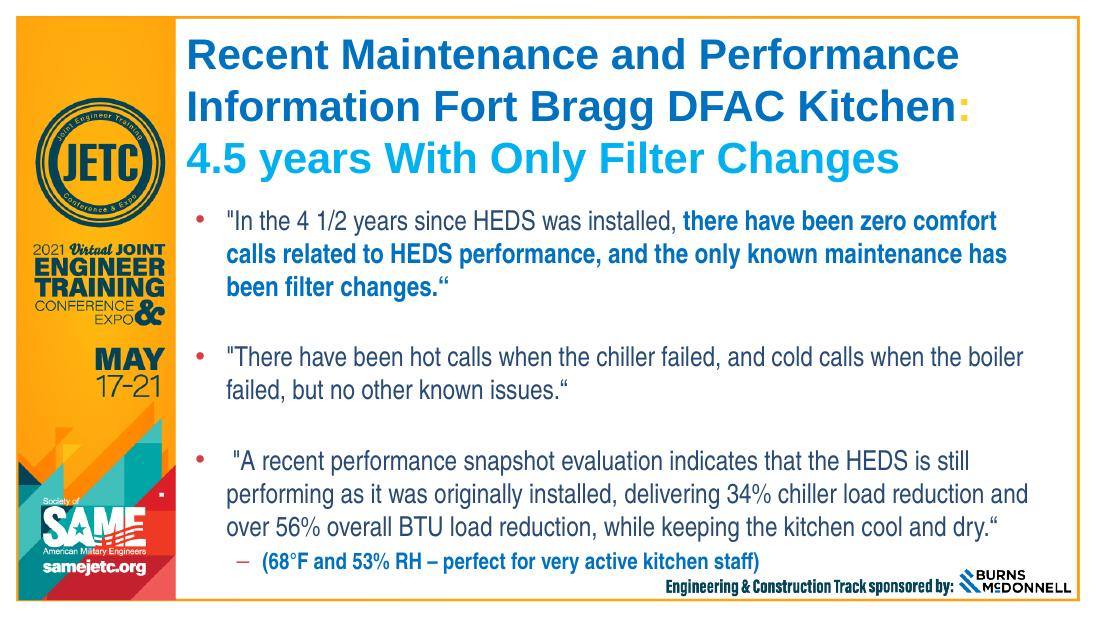
Fort Bragg dining facility kitchen maintenance record: 4.5 years with only filter changes, zero comfort calls related to HEDS performance, still delivering 34% chiller load reduction and over 56% overall BTU load reduction while keeping the kitchen at 68°F and 53% RH
Fort Bragg DFAC maintenance record · 4.5 years of operation on filter changes alone · USACE-CERL / ESTCP
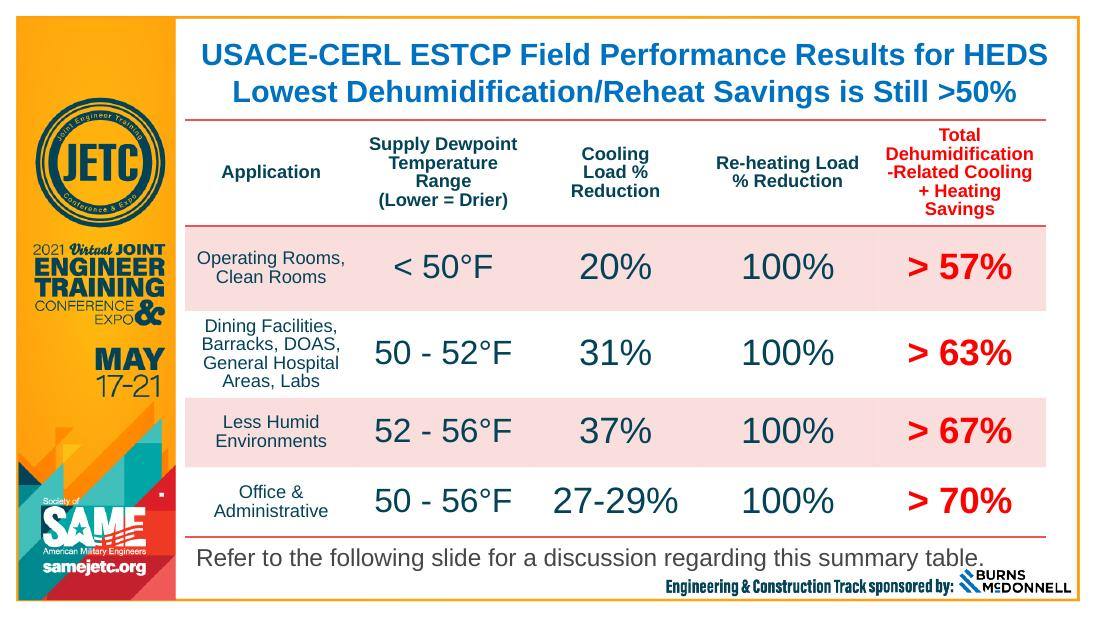
USACE-CERL ESTCP field performance results for HEDS: lowest dehumidification/reheat savings is still greater than 50% — operating rooms and clean rooms below 50°F dewpoint save over 57%, dining facilities and barracks over 63%, less humid environments over 67%, office and administrative areas over 70%, with 100% reheat load reduction in every application
USACE-CERL ESTCP field results · the savings floor by application · 100% reheat reduction in every row

Timken Museum of Art, San Diego

Irreplaceable artwork, ±5% humidity, a 60-year-old CAV-reheat plant — and three separate state and federal programs testing in parallel. NREL documented 39–72% electrical and 64–99% fossil savings by season and mode; CalNEXT's independent annual extrapolation reached 79%/91% and recommended statewide utility incentives. The one-week off-switch test: consumption spiked 87% (electric) and 129% (fossil) without HEDS, then fell back when HEDS was re-enabled.

CalNEXT HEDS test project summary results slide: actual HEDS project at the Timken Museum of Art converted CAV-reheat to HEDS energy recovery VAV reheat plus HEDS HVAC optimization software — 79% electricity and 91% natural gas annual savings; CAV-reheat conversion path 35%/77%; VAV-reheat conversion path 56%/80%
CalNEXT test project summary · all three conversion paths, annual savings

Naval Base Guam

Guam is one of the most persistently humid environments on Earth. HEDS cut cooling load 43% and covered 100% of reheat from recovery, while 19°F+ chilled-water differentials drove >75% pump savings on top. Total annual savings exceed 65%. Several hundred thousand data points now calibrate the NREL EnergyPlus module. The Navy's written conclusion: better potential than current alternatives such as desiccants.

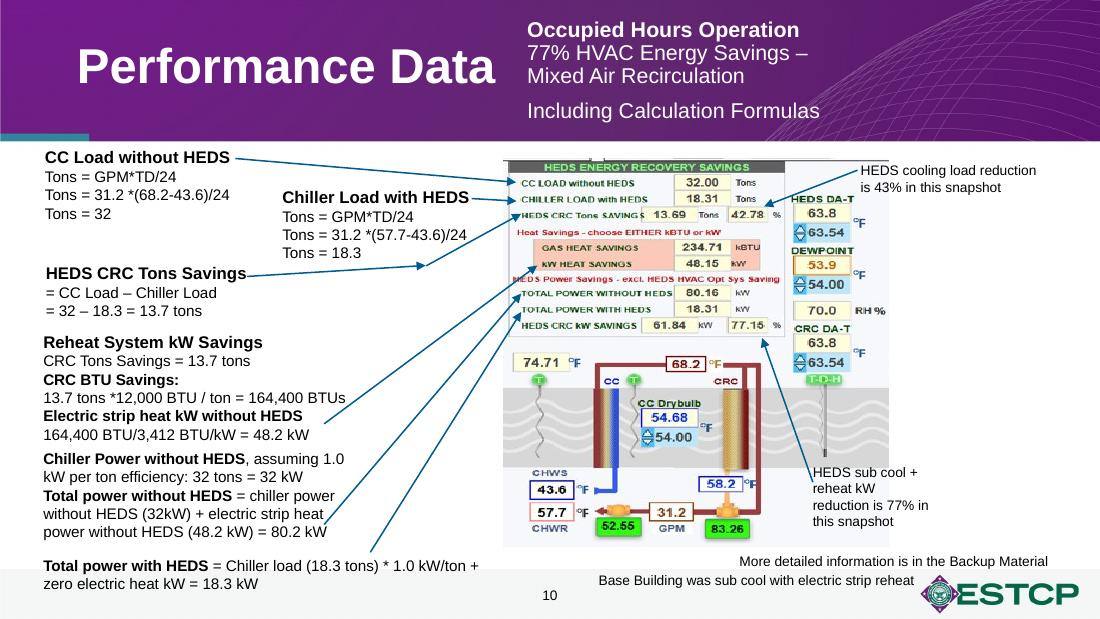
ESTCP performance data from Naval Base Guam with calculation formulas: 32 tons cooling load without HEDS versus 18.3 tons with HEDS, 43% cooling-load reduction, 77.15% HVAC energy savings in mixed-air recirculation during occupied hours
Naval Base Guam ESTCP performance data · occupied hours · 77% HVAC energy savings

Report library

Read the source documents.

Independent reports by the national laboratories and programs that instrumented the sites. Copies available on request where not publicly posted.

NREL

NREL/TP-5500-94847

Full-year HEDS evaluation at the Timken Museum — summer, winter and spring test campaigns. 39–72% electrical, 64–99% fossil savings by mode.

Request via the Technical Library →
NREL

NREL/TP-5500-90261

Timken HEDS measurement & verification, summer 2023 — the first NREL field campaign on the technology.

Request via the Technical Library →
CalNEXT · CA IOUs

CalNEXT ET22SWE0040

Independent field study (ASK Energy / AESC) for PG&E, SCE and SDG&E under California's emerging-technology program — final report May 2025. 79% kWh / 91% therms annual extrapolation; statewide incentive recommendation.

Request via the Technical Library →
DoD ESTCP

ESTCP EW-201344

The foundational federal validation: Fort Bragg and Tinker AFB six-month dehumidification-season instrumented testing (EW-201344). The follow-on to this testing was the Naval Base Guam program.

Request via the Technical Library →
NREL TTF

Thermal Test Facility campaign

59 steady-state lab test points across loads, airflows, and chilled-water temperatures — the calibration set for the national-laboratory-created EnergyPlus HEDS module.

Request via the Technical Library →
Conservant

HEDS Design Assistance Guide

Coil-selection logic, full 17-column performance matrices, hydronics and materials — for practicing design engineers designing HEDS projects. Available under NDA.

Request under NDA →

What's next

A national-laboratory-created simulation module.

The DoD and DOE found that existing tools — including EnergyPlus — significantly under-calculate HEDS savings. The technology outperforms the models: the opposite of the usual problem. NREL's lab campaign plus several hundred thousand field data points from Timken and Guam are building the EnergyPlus module that will let any engineer, anywhere, model HEDS with the confidence of a national-lab-created tool.

See it live, not on a slide.

On a call with the inventor, connect to an operating HEDS project and watch the savings profile in real time — so you can see the system running in the real world.