About Conservant Systems
Founded at the request of the U.S. Army Corps of Engineers.
Conservant Systems exists because the Army had a problem no product could solve: barracks and mission-critical facilities in humid climates were wasting enormous energy — cooling air, then paying again to reheat it — while mold and failed humidity control degraded buildings and readiness. The Corps asked its longtime HVAC subject-matter expert to fix the physics. HEDS is the answer.
The inventor
Scot M. Duncan, P.E.
Inventor & President, Conservant Systems. For more than 30 years, Scot has served as an HVAC subject-matter expert to the U.S. Army Corps of Engineers and Naval Facilities Engineering Command — the engineer federal agencies call when conventional systems can't hold spec.
Before HEDS, Scot invented the Load Based Optimization System (LOBOS-EE / LOBOS-DR), deployed to optimize chiller plants at scale. HEDS extends that optimization pedigree into a patented hardware-plus-software platform — and Scot still personally walks engineers through live operating projects on technical calls.
- 45 years hands-on — started as a Honeywell controls field technician assistant at 15; Honeywell Engineering school, BSME, Cal Poly Pomona; registered Mechanical Engineer, California.
- 30+ years as HVAC subject-matter expert to the U.S. Army Corps of Engineers and NAVFAC; trained 500+ USACE professionals across 100+ seminars; co-author, IEA ECBCS Annex 46.
- Before HEDS: 500,000+ ton-hours of thermal energy storage across 80+ retrofits, and ASHRAE award-winning central plants. Other TES plants at LAX, SFO, DFW, Sky Harbor, Walt Disney Concert Hall and the Orange County Performing Arts Center.
- 28 patents issued or pending across HEDS' six coverage layers.
Invented by one engineer. Built to run without him.
HEDS is documented as a system, not a person: the Design Assistance Guide, factory-programmed controls, train-the-trainer programs and M&V protocols mean your engineers train your engineers. Units are manufactured on standard OEM production lines and can be commissioned remotely — the FDA laboratory on Puerto Rico, the NEX on Guam and the Kadena Air Base installation in Japan were commissioned with zero Conservant personnel on site.
The record
A decade of proving it.
- 2016
First federal field tests
Earlier-generation HEDS units enter ESTCP validation at Fort Bragg, NC and Tinker AFB, OK under USACE-CERL — establishing the >57% savings floor and 100% reheat elimination.
- 2020
The FDA laboratory on Puerto Rico starts up remotely
The FDA laboratory on Puerto Rico is started up remotely in January of 2020, just as Covid was shutting the world down. HEDS operated seamlessly.
- 2021
Secretary of the Navy Energy Excellence Award
Naval Weapons Station Seal Beach UESC delivers $927K first-year savings at zero simple payback — and a financing template that counts labor productivity.
- 2022
DOE High Impact Technology Catalyst
DOE selects HEDS; GSA Green Proving Ground and the CalNEXT emerging-technology program launch parallel evaluations at the Timken Museum of Art.
- 2023–24
NREL evaluates the Timken
Three-season instrumented testing (TP-5500-90261, TP-5500-94847): 39–72% electrical, 64–99% fossil savings — and the off-switch week that spiked consumption 87%/129%. Patents assigned to HEDS Holdings LLC with clean title.
- 2025
Independent confirmation, OEM manufacturing, extreme climates
CalNEXT's final report finds 79%/91% annual savings and recommends statewide incentives. Johnson Controls builds HEDS on its standard production line (Onslow: savings >50%). Guam, FDA San Juan and Kadena prove tropical, 100%-OA and fully remote international deployment. NREL completes 59 lab test points toward the EnergyPlus module.
- 2026
Scaling the platform
Nine active installations worldwide with more in design and construction — including two airports, a SoCal museum expansion, another SoCal museum, DoD healthcare and the Naval Medical Center San Diego demonstration with CEC and EPRI.
Recognition
Nineteen federal awards. Nine federal agency investors.
Secretary of the Navy Energy Excellence
For the NWS Seal Beach UESC transformation.
3× ESTCP wins
Selected three times by the DoD's premier technology-validation program.
AFWERX "Base of the Future"
Challenge winner for installation energy resilience.
"Call for Innovation" winner
Recognized as a leading sustainable building solution.
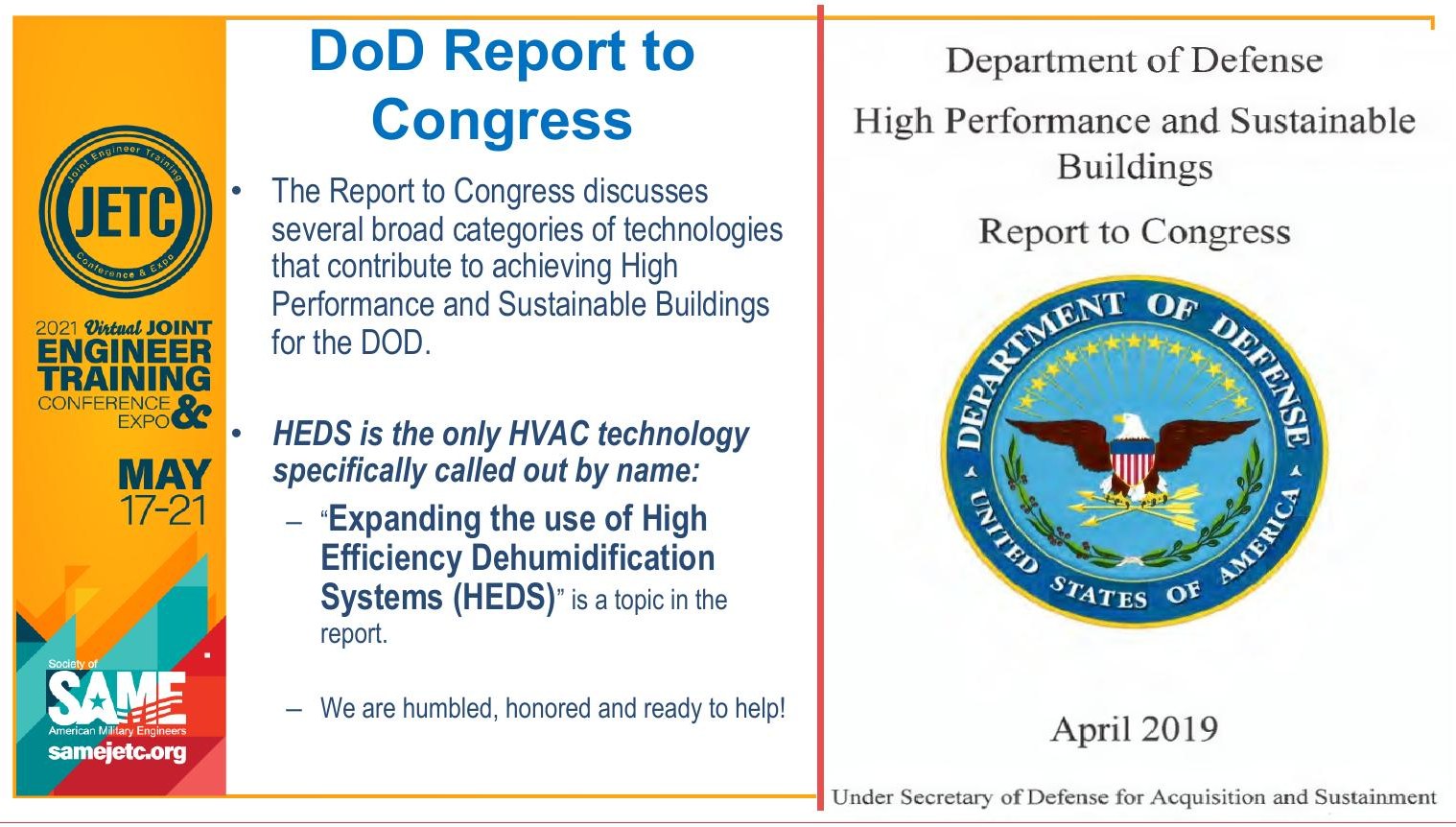
Named in the DoD report to Congress
The only HVAC technology cited by name in the April 2019 High Performance & Sustainable Buildings Report to Congress.
Why we do this
Buildings shouldn't pay for energy twice.
Roughly half of a commercial building's energy goes to HVAC, and in humid climates much of that is spent cooling air only to reheat it. Recovering that waste — at global scale, on a 25-billion-square-foot U.S. installed base — is one of the largest, most bankable decarbonization and electrification opportunities in the built environment. That's the company's mission, and the technology is proven. Now it's a matter of scale.
How we work
From first call to verified savings.
- 01
Tell us about your building
A 30-minute call with an engineer — not a sales script. We screen your humidity loads, chilled-water plant and climate honestly. If HEDS isn't a fit, we'll tell you.
- 02
See it running, live
We connect you to an operating HEDS project in whatever mode it's running that day — because we know how 50%+ savings claims sound until you watch the meters.
- 03
Design and build with your team
Our engineers support selection, hydronics and controls alongside your engineer of record and contractor. Units are built on standard OEM lines and can be commissioned remotely.
- 04
Verify the savings
Energy recovery savings via measurement & verification is built into every HEDS controller. The results are measured against your baseline — the same way NREL and the DoD measured ours.
Talk to the people who built it.
Technical calls with the inventor. Straight answers, live data, and a clear read on whether HEDS fits your buildings.