Who we serve
What can HEDS do for you, your clients — and your company?
Pick your seat at the table. Building owners, property managers, labs and pharma, manufacturers, healthcare systems, defense contractors, technology portfolios, federal facilities — proven from mild coastal air to the wettest climates on Earth.
- Savings averaged over 50% at third-party-validated projects across the USA, Puerto Rico and Guam.
- Comfort improved at every facility where HEDS has been fully integrated into the HVAC system.
- Maintenance costs reduced at each facility.
- First and lifecycle costs can be lower than any other third-party-validated HVAC system.
Validated by the U.S. Department of Energy · GSA Green Proving Ground · DoD ESTCP · NREL · California's CalNEXT program
When widely deployed, HEDS projects can create $billions in revenue and increases in CRE valuations — across a variety of verticals.
The economics
The sample base case: a 1M SF Class A office.
From the HEDS financial model, savings held inside the independently validated band:
Every vertical has its own model — life science adds batch-failure and inspection-risk avoidance; ESPC monetizes 20 years of guaranteed savings in a single vehicle; hospitals run ~3× commercial energy intensity. We'll walk your vertical's numbers with you on a call. Or run your own first →
CRE owners & investors
Convert owner CapEx into tenant OpEx.
For institutional and private owners alike, HEDS turns the HVAC replacement you've been deferring into an upgrade that pays for itself over time from the energy line — using other people's money. HVAC is the largest controllable line on a Class A operating budget, and 50–80% of it is recoverable waste.
- 6x–14x projected return on the incremental HEDS investment, in a short period — $1.01+/SF landing straight on NOI.
- Comfort compounds into value: better comfort supports higher lease rates, more leased square footage, improved tenant productivity, fewer turnovers and lower TI costs. Over time, across a portfolio, that's $billions in value-add.
- Sidestep the mandates: LL97 exposure on a 1M SF tower runs ~$364K/yr at 2030 thresholds; BPS rules are active in 30+ cities. HEDS cuts HVAC emissions ~50% at the source.
Train one team, deploy portfolio-wide — if your staff can change an air filter, they can maintain a HEDS unit. Billions of SF could benefit every year.
Property managers — majors & challengers
The firm that brings HEDS wins the mandate.
For the largest platforms — firms like CBRE, JLL, Cushman & Wakefield and Colliers — HEDS is how you lock in clients by growing their net asset value, and how you take share from peer rivals.
For the next tier, it's sharper still: proof you can create more owner value than the majors, and a way to move up the food chain at their expense.
- Lock in the portfolios you manage: verified 50%+ HVAC savings and a $1.01+/SF NOI lift, delivered through your platform, make management contracts sticky.
- Win the portfolios you don't have: attract new owners with value creation their current manager isn't offering.
- Move buildings up the value chain — comfort, compliance and NOI in one motion, with the documentation owners can take to their lenders.
- Billions of SF across managed portfolios could benefit every year.
Healthcare systems & payers
Where the air is the product.
Hospitals spend 50–60% of building energy on HVAC at nearly 3× commercial intensity, with 100% outside air required for many loads. And the stakes run past energy: estimates derived from CDC data put airborne healthcare-associated infections (HAIs) at 51,000–124,000 per year in the U.S., costing hospitals and payers an estimated $3.1–4.5 billion annually. HVAC performance is a patient-safety and financial issue, not just a facilities issue.
- >95% single-pass pathogen capture/kill standard; 99.9%+ in the anti-viral configuration — against an airborne HAI burden costing U.S. hospitals $3.1–4.5B annually.
- Temperature, humidity and pathogens controlled together — to 40% RH where required — beyond most operating-room standards.
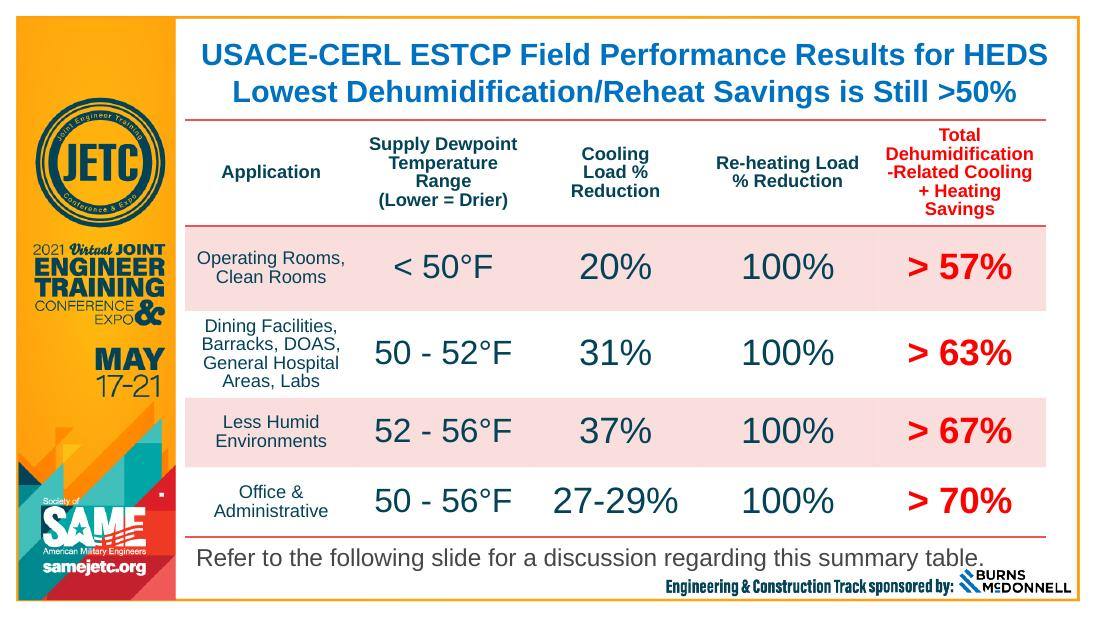
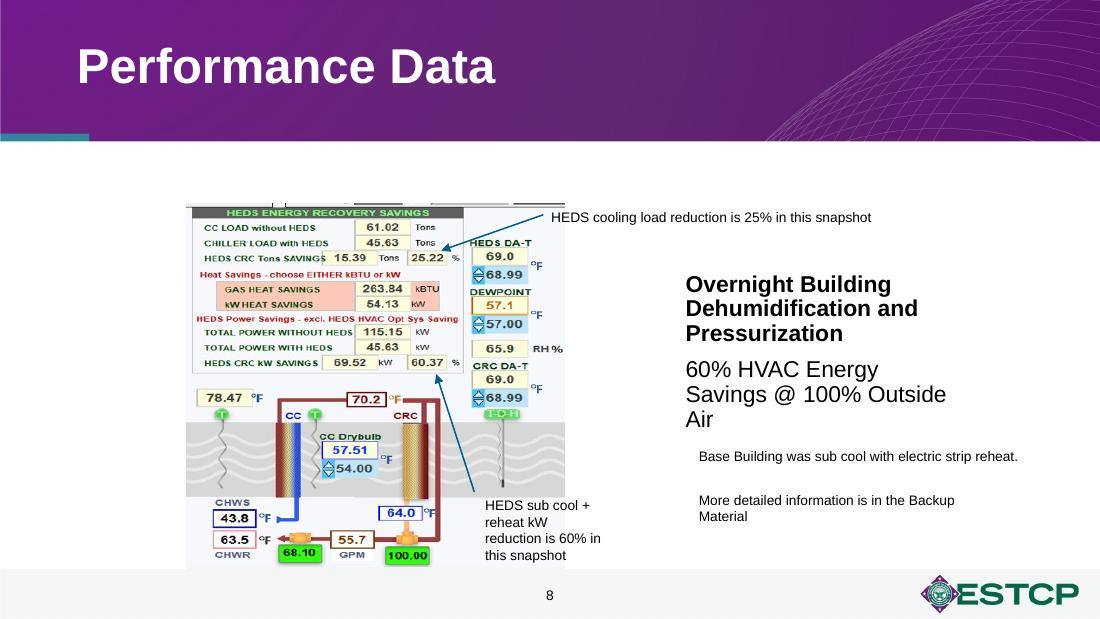
- >57% savings floor even in operating rooms and clean rooms with sub-50°F dewpoint, temperature and RH specs (ESTCP).
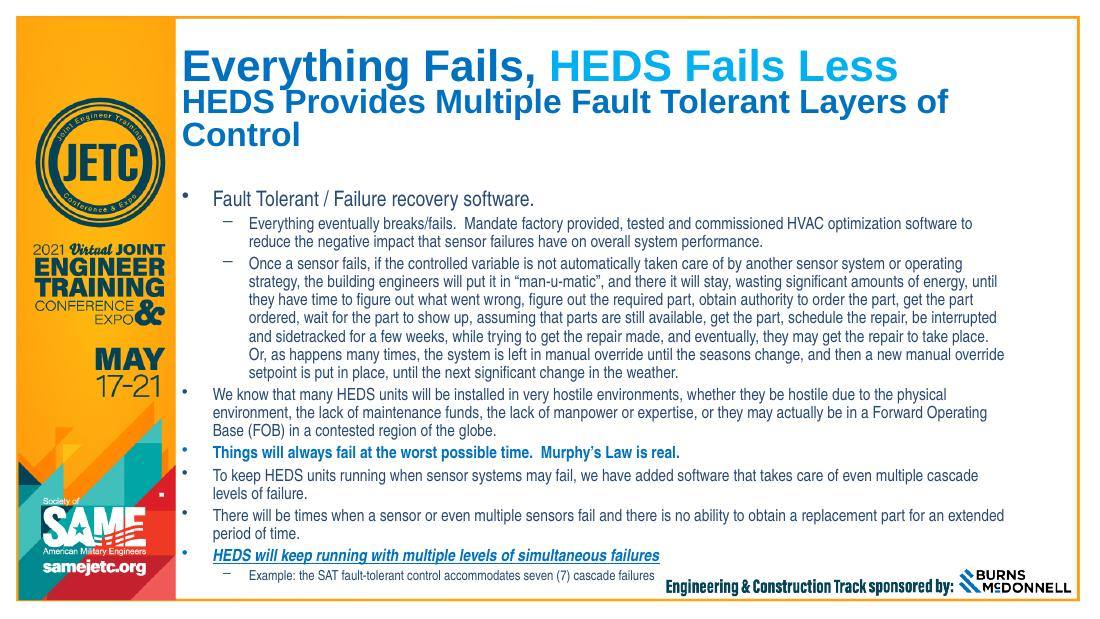
- Resilience proven: the FDA San Juan lab held spec through a 3-of-4 chiller failure on a non-peak load day. The control software is designed to be fault-tolerant — sensors eventually fail, and HEDS helps reduce the problem.
Laboratories, pharma & manufacturing
Better-controlled loads make better products.
In humidity-sensitive production — pharma, precision manufacturing, coatings, process facilities — an out-of-tolerance day isn't an energy problem, it's a throughput and quality problem. Better control of the loads creates better product quality and lower HVAC-caused product losses, and the 24/7/365 duty cycle means the energy savings compound into rapid ROI.
- Work stoppages ended: at NWS Seal Beach, maintenance work halted whenever conditions drifted beyond the acceptable limits. The Navy counted the recovered labor in the financing — a productivity-based payback precedent.
- Borderline days eliminated: tight RH control ends the out-of-tolerance days that cost pharma and process operators millions annually in rework, lost product and risk.
- 24/7/365 economics: continuous operation means every saved kilowatt repeats around the clock — the fastest ROI profile of any vertical.
- Proven in demanding duty: USAF avionics lab, high-volume military kitchen, 100% outside-air FDA lab, retail and administrative loads on Guam — with a >57% savings floor in the hardest applications. Millions of SF could benefit every year.
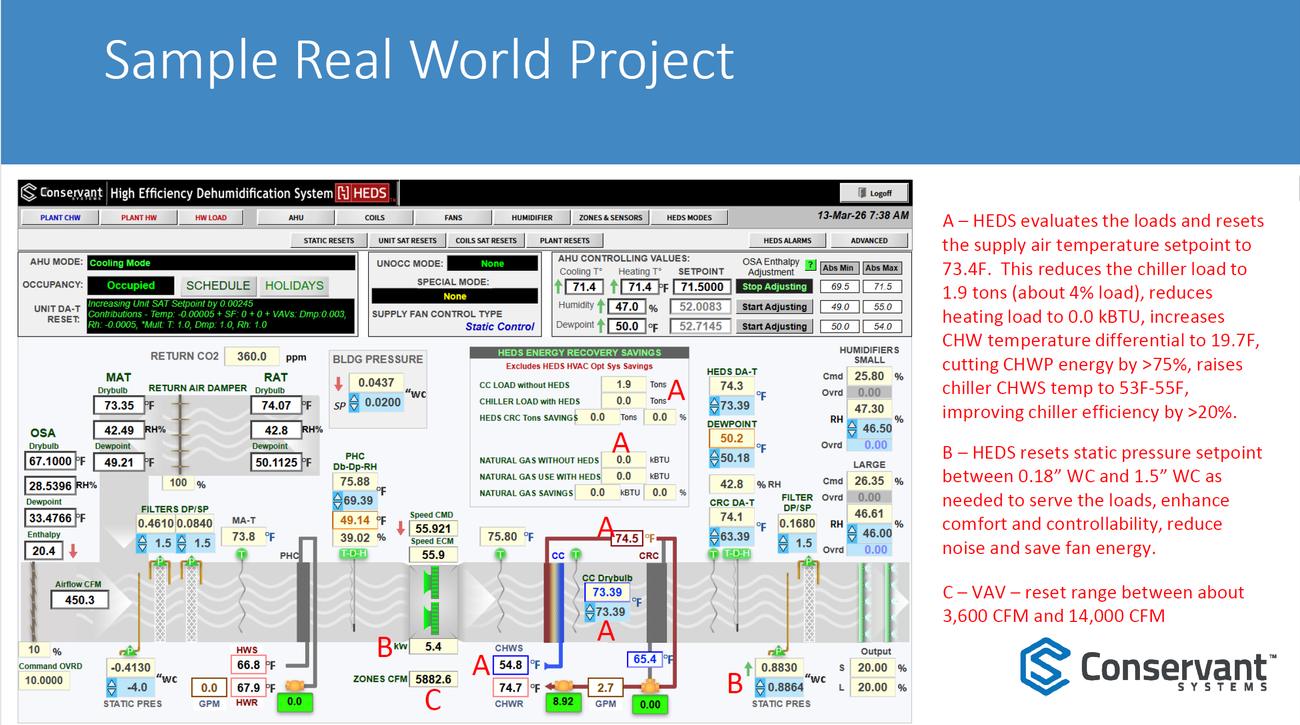
- Light loads can be the hardest to serve — in one museum example, HEDS serves a 4% load while holding temperature within 0.1°F, RH and dewpoint within the targeted range, and still producing a 19.7°F ΔT.
Defense & aerospace manufacturers
Fixed-price contracts make every wasted kilowatt a profit leak.
From the legacy primes — firms like Lockheed Martin, RTX, Northrop Grumman, General Dynamics and Boeing — to the new generation of manufacturers like Anduril, defense production is expanding at home and abroad: munitions, drones, equipment. HEDS-based HVAC can be the least-first-cost and lowest-lifecycle-cost option for exactly these facilities — and it's already proven on DoD installations.
- Fixed-price reality: as fixed-price contracts become the norm, every trimmed utility dollar and every avoided rework hour drops straight to the bottom line.
- Proven at mission-critical DoD facilities: at one, year-one savings totaled $927,000 while materially reducing lost-labor-hour costs — and the HEDS-based system cost less than a like-for-like replacement of the old system.
- Second and third shifts: as capacity expands, energy and quality-control costs grow with runtime — HEDS turns the HVAC line from a cost drag into a margin contributor.
- New construction too: augmenting even newly built or expanded plants with HEDS can pay — and it keeps production running through extreme peak-weather loads.
Technology & hyperscale portfolios
NegaWatts, distributed across the grid.
For technology companies operating at portfolio scale — the AWSs, Microsofts, Alphabets, Metas, Apples, Teslas and SpaceXs of the world — HEDS creates "NegaWatts": verified energy reductions across office, laboratory, manufacturing and data-center facilities that offset the load growth everyone is racing to serve.
- Deployable wherever chilled water runs — HEDS projects distribute around the grid, freeing capacity at every site that uses chilled water as its cooling resource.
- Verified, not estimated: national-lab-grade M&V is built into every controller — reductions your sustainability reporting can stand on.
- Portfolio playbook: remote factory commissioning and one train-the-trainer program scale across a global footprint without scaling specialty headcount.
Federal & DoD
Developed for the Corps. Proven across the services.
HEDS was founded at the request of the U.S. Army Corps of Engineers and is deployed at Army, Navy, Air Force and FDA facilities from Southern California, to North Carolina to Guam, Puerto Rico and Okinawa. ESPC and UESC vehicles can fund the upgrade from the savings — no upfront appropriations — and NWS Seal Beach set the template, including labor-productivity savings in the financing structure.
- ESPC monetizes 20 years of guaranteed savings in one transaction — and deep verified savings make the vehicle work harder.
- Mission-critical fault tolerance: cascaded failsafes designed for DoD loads, proven in live plant failures.
- Named to Congress: the only HVAC technology cited by name in the DoD's High Performance & Sustainable Buildings Report to Congress.
- See: Seal Beach · Fort Bragg & Tinker · Guam
Universities, K-12 & institutional
Campus loops love high delta-T.
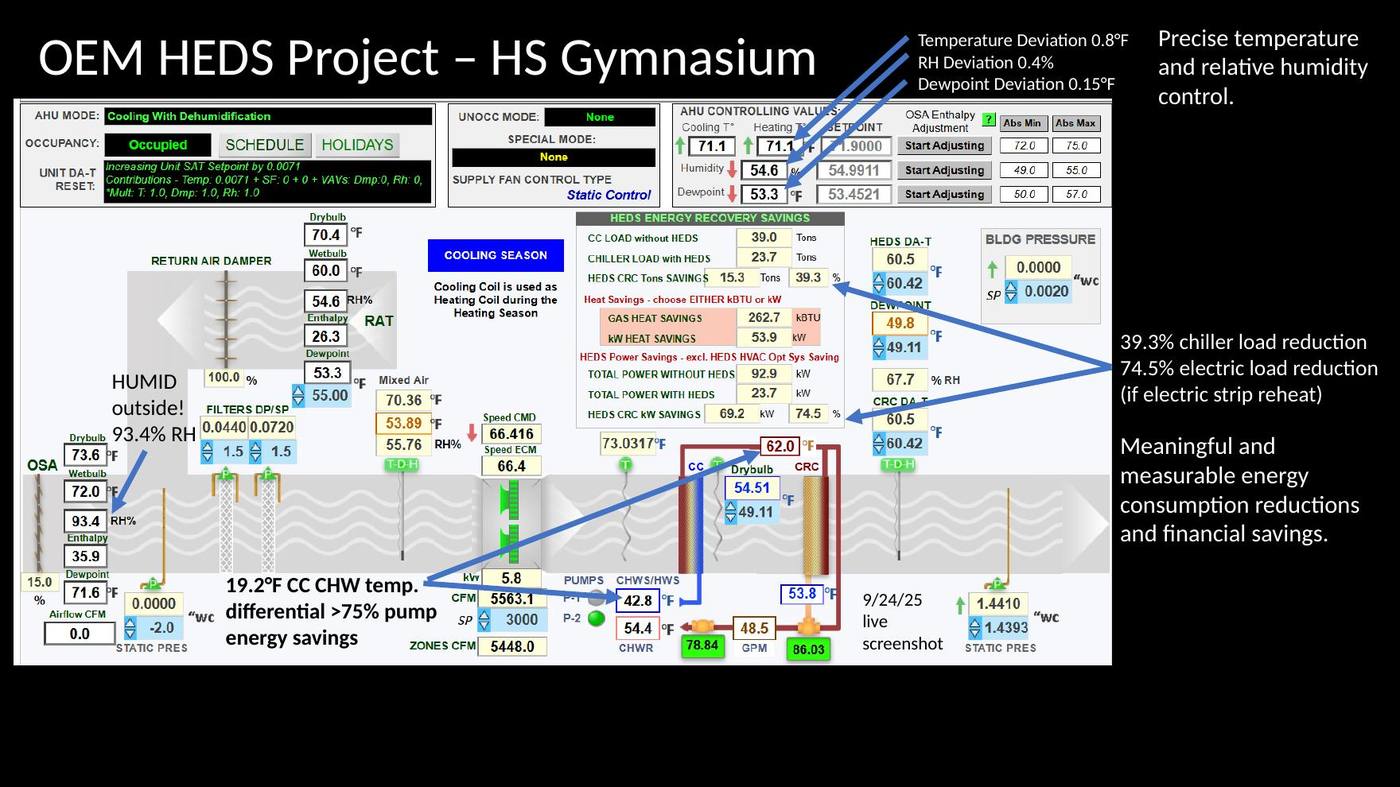
Campus chilled-water systems are the classic Low Delta-T victims — over-pumped loops, stranded tons, buildings that can't get enough cold water. HEDS coils and HVAC optimization software restore the ΔT, effectively doubling distribution capacity and freeing the site for growth without new chillers.
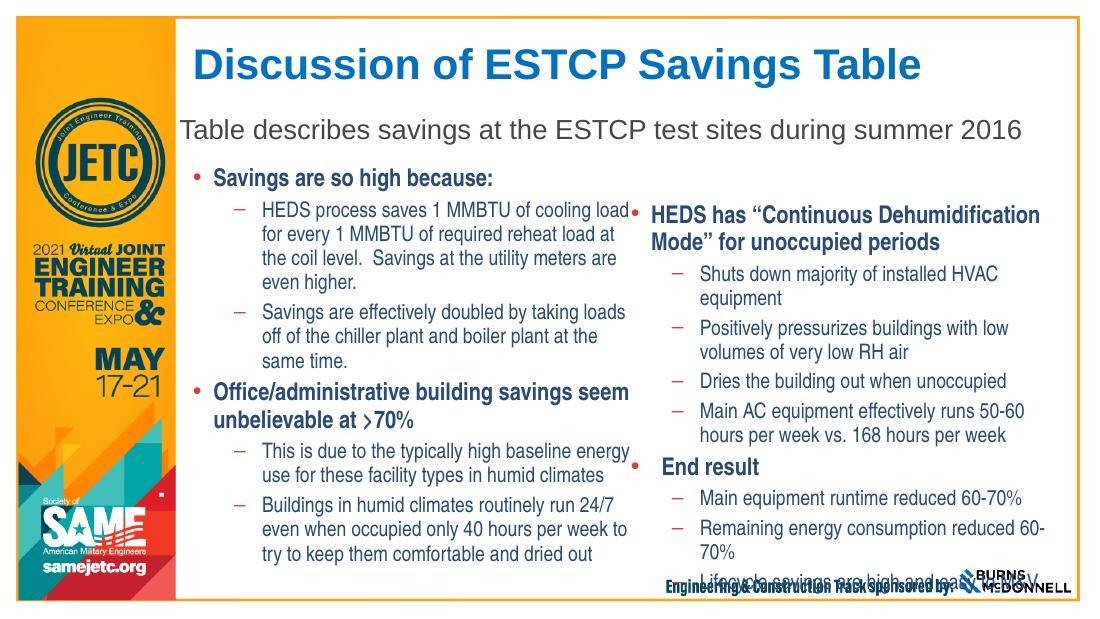
- Up to 100 hrs/week of avoided equipment runtime for 40-hour occupancies forced to run 24/7 — gyms, halls, administrative and office spaces.
- >70% savings on office/admin-type loads in federal testing.
- IAQ standard: MERV 16 + UV-C air purification protects occupants as a by-product of the design.
- The examples span the load range — from a 4% load (19.7°F ΔT) to >80% load (26.4°F ΔT).
Museums & archives
Precision for the irreplaceable.
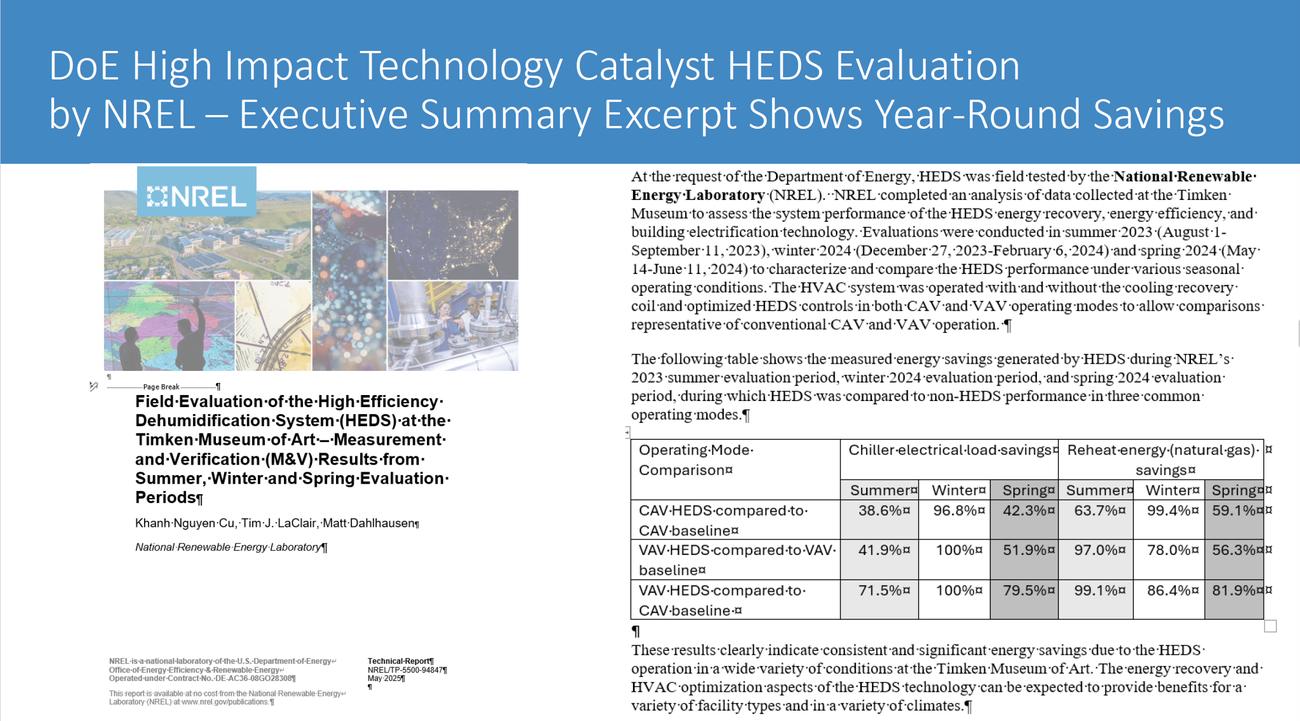
Collections demand tight, stable RH around the clock — historically the most energy-hungry duty in buildings. The Timken Museum result is the category proof: precise conservation conditions and 79% annual electrical savings, validated by independent state and federal programs at once.
- ±5% RH control, year-round, with recovered — not purchased — reheat.
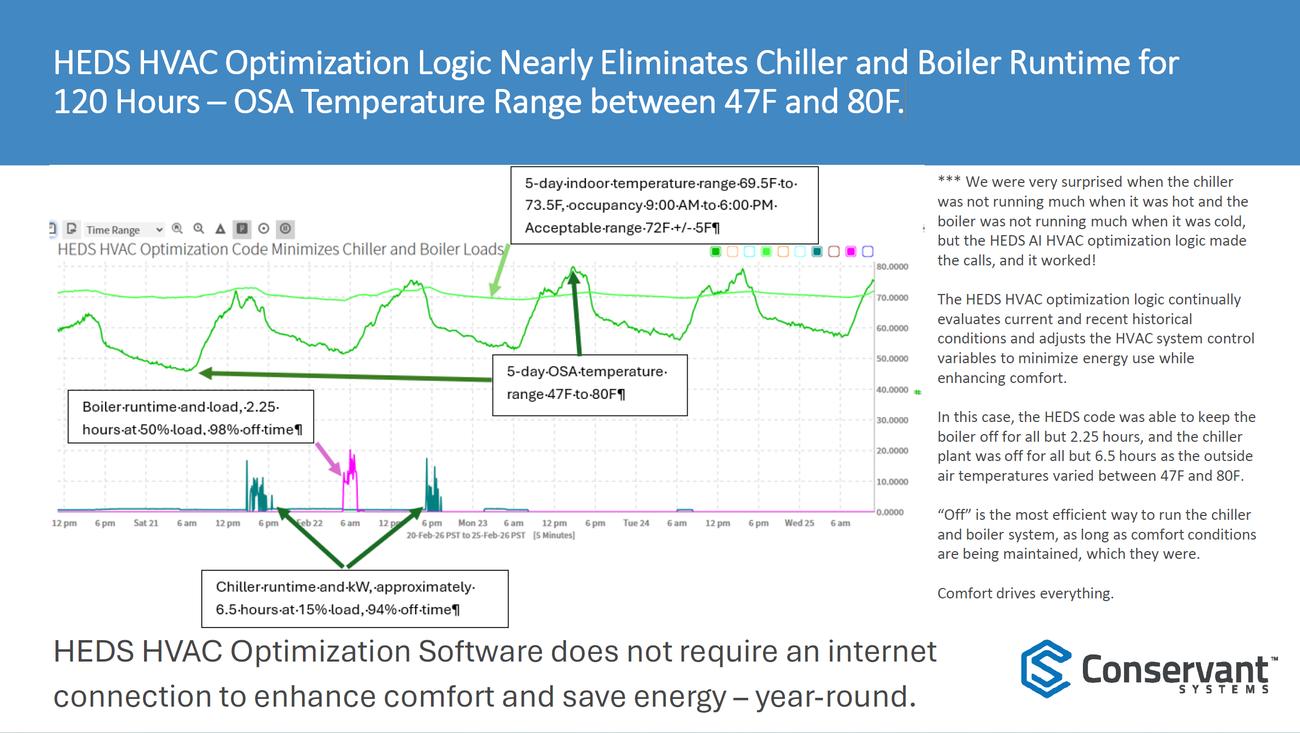
- Thermal Flywheel operation nearly eliminated chiller and boiler runtime at a fine-arts museum across a 47–80°F outdoor range, for a five-day span.
Design influence: based on the multi-year, state- and federal-program-proven success of HEDS at the Timken Museum, a nearby university building a new museum is changing its design mid-stream to utilize the HEDS technology. See the Timken case study →
Indoor agriculture
The building makes its own humid climate. HEDS thrives on it.
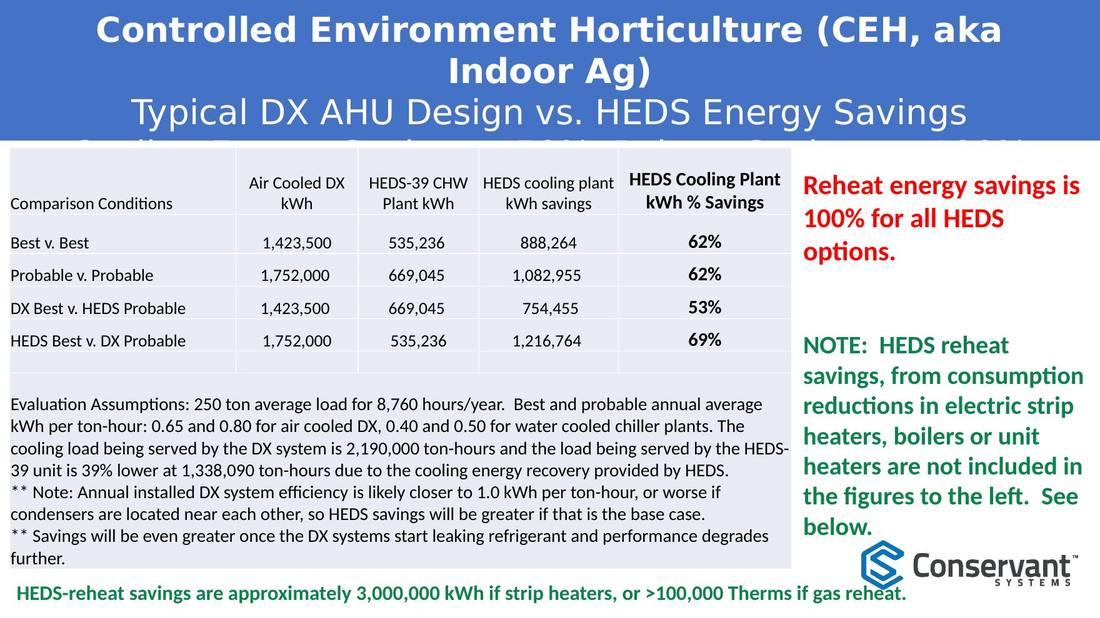
Controlled-environment horticulture creates enormous, near-continuous dehumidification and reheat loads regardless of the weather outside — exactly the duty HEDS was engineered for. The loads drive the fit, not the ZIP code — grow-house loads closely mimic the loads on Guam.
- Continuous latent duty is where the recovery coil recovers the most — the same physics that delivered 77% daytime HVAC savings on Guam.
- Tight RH bands suppress mold and mildew pressure on the crop without desiccant regeneration energy.
- Simple maintenance keeps grow rooms running: fans and valves, no wheels or desiccants to service around a live canopy.
Build, install or finance HVAC for a living?
Construction firms, mechanical contractors, AHU and integrated OEMs, ESCOs and Energy-as-a-Service providers have their own page — including licensing, manufacturing and deployment-network paths. For partners →
Run your building's numbers.
Send us your facility type, square footage and energy profile — we'll frame the HEDS economics for your specific vertical, honestly.