Conservant Systems · July 2026 · 4-minute read
Every facilities director knows the 2 a.m. call: water where it shouldn't be, a musty smell on the third floor, a tenant threatening to escalate. What's less understood is how mechanically ordinary the causes are. Conventional systems have typically been sized based on the dry bulb (sensible) loads, not the dehumidification (latent) loads, so condensation, microbial growth and comfort complaints tend to live inside "normal" operation.
Where the moisture actually comes from
- Condensate blow-off. High face velocities strip water droplets off the cooling coil and carry them into the ductwork, where they feed mold — and re-evaporate, re-humidifying the air the coil just dried (wasting the cooling and heating energy that dried it).
- Waterlogged coil sections. Many air handlers use 48″+ tall coil banks to cut build cost. In humid service, the bottom 10–12″ of the coil fins can't drain fast enough, stays waterlogged, and passes almost no air — a permanent wet surface inside the unit that increases fan energy and air velocities through the "open" section of the coils.
- Undersized coils. Coils selected for peak dry-bulb, not peak latent load, simply can't wring out enough moisture on the muggy days that matter.
The HEDS design attacks each cause directly: low face velocity, ≤33″ coil heights between drain pans so condensate drains cleanly, 300%+ more coil surface area for latent duty, and UV-C running continuously at the coil and drain pans. The result is ±5% RH control, year-round — with the reheat that holds it coming from recovered energy, not the gas bill.
The health layer
Standard HEDS filtration — MERV 11 pre-filter, MERV 16 secondary, UV-C — achieves greater than 95% single-pass pathogen capture/kill, 99.9%+ in the anti-viral configuration. That's cleaner than the air in most operating rooms, delivered as a by-product of the dehumidification design. It matters most where air is the product: hospitals fighting healthcare-associated infections (a $3.1 to 4.5B annual U.S. problem, with 68% of airborne pathogens transmitted through HVAC systems), labs protecting samples, schools and offices protecting people. At coastal sites, the same filtration removes airborne salt before it corrodes the HVAC system and building from the inside.
The money layer: retention
Tenants rarely name humidity when they leave — they name comfort, smell, and the sense the building is tired. But the drivers are measurable: RH swings, hot/cold complaints, stained tiles, remediation disruptions. Green-certified, comfortable buildings show roughly 17% longer lease durations in CBRE/JLL research, and HEDS qualifies for LEED and WELL credits. For an owner, that retention effect stacks on top of the energy and penalty math (see the LL97 brief) — fewer concessions, fewer vacancies, lower TI churn.
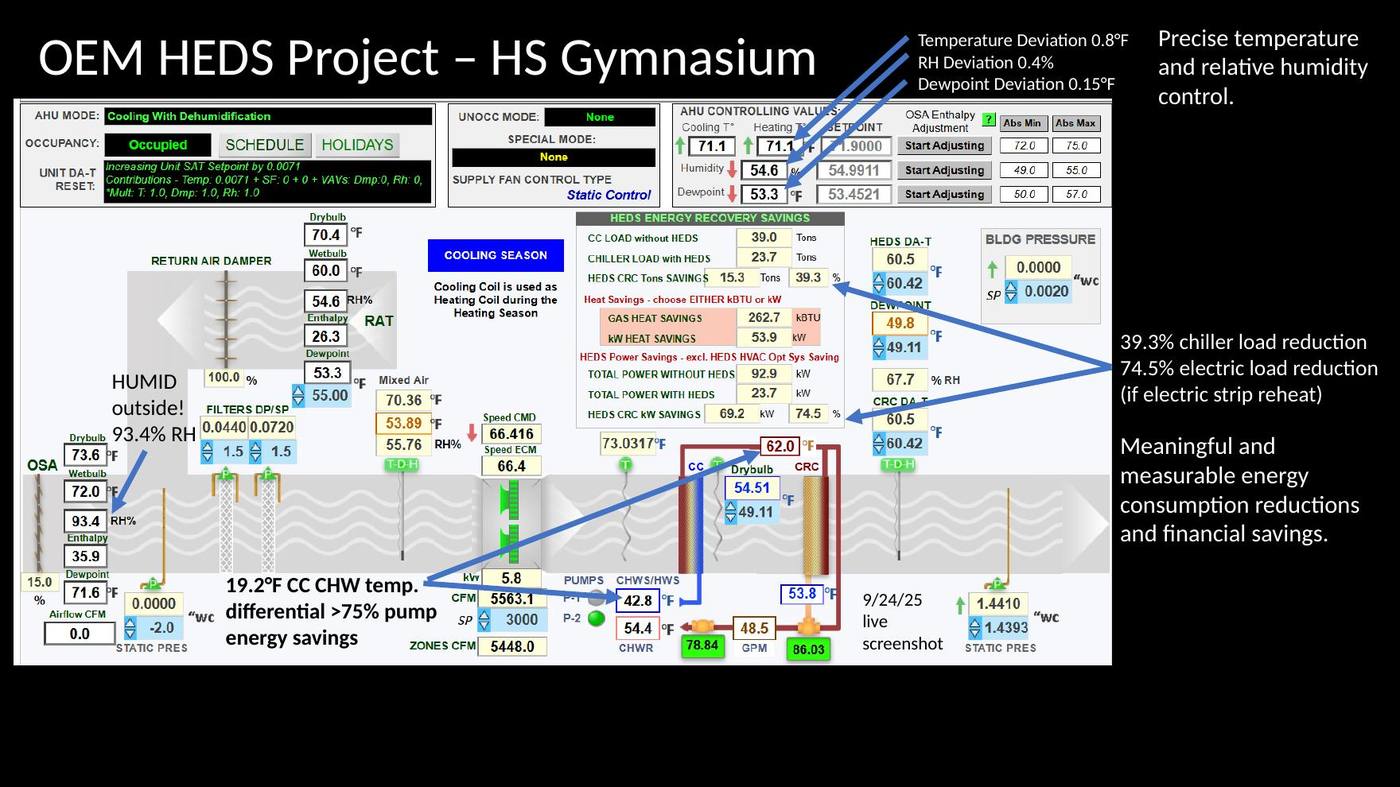
Field proof that precision and savings coexist: at 93.4% outdoor humidity, the Johnson Controls-built HEDS unit and HVAC optimization software in Onslow, NC holds RH within 0.4% of setpoint — while cutting HVAC energy use by more than half.
The takeaway
Humidity control isn't a comfort nicety bolted onto an energy project — it's the root system of building health, tenant retention and a large share of HVAC waste. Solve it structurally, at the coil and the control system, and the 2 a.m. calls get rare while the operating statement gets better. That's the design brief HEDS was built to — originally for Army facilities fighting exactly this problem.
Humidity problems at your building? We'll walk the loads with you.